
Blog Detail

Introduction Small and mid-sized businesses (SMBs) are no longer "too small to be targeted." Cybercriminals increasingly focus on SMBs because of limited security resources, growing cloud adoption, remote work environments, and the absence of dedicated cybersecurity teams. Managed Security Services...

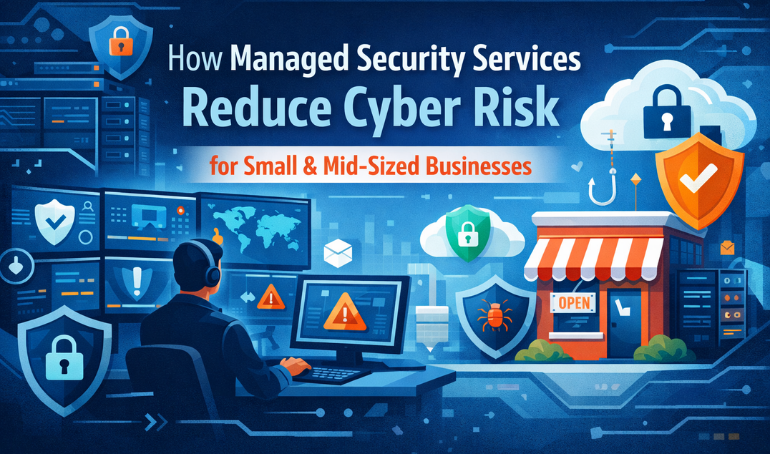
How Managed Security Services Reduce Cyber Risk for Small & Mid-Sized Businesses

Introduction

Small and mid-sized businesses (SMBs) are no longer “too small to be targeted.” Cybercriminals increasingly focus on SMBs because of limited security resources, growing cloud adoption, remote work environments, and the absence of dedicated cybersecurity teams.

Managed Security Services (MSS) help SMBs reduce cyber risk by providing continuous monitoring, advanced threat detection, incident response, vulnerability management, and compliance support through a specialized provider known as a Managed Security Service Provider (MSSP).

What Are Managed Security Services?

Managed Security Services (MSS) refer to outsourced cybersecurity operations where an MSSP manages and protects an organization’s digital infrastructure, security systems, and response processes.

Instead of relying only on internal IT teams, businesses gain access to enterprise-grade security tools, expert analysts, and 24/7 protection without building costly internal security operations.

Core MSS Capabilities:

  • 24/7 security monitoring
  • Threat detection and response
  • Managed SOC (Security Operations Center)
  • SIEM management
  • Managed Detection and Response (MDR)
  • Vulnerability management
  • Endpoint security
  • Cloud security
  • Compliance monitoring

Why SMBs Face Higher Cyber Risk

SMBs operate in high-risk digital environments with limited detection maturity and security infrastructure.

Risk Factor Business Impact Cyber Impact
Limited IT budgets Weak security tools High breach risk
No security team Slow response Extended attack duration
Cloud misconfigurations Data exposure Compliance violations
Remote work models Endpoint risk Expanded attack surface
Regulatory complexity Legal exposure Financial penalties

Without proactive protection, SMBs rely on reactive security, which increases financial, operational, and reputational risk.

How Managed Security Services Reduce Cyber Risk


1. 24/7 Security Monitoring (Managed SOC)

Continuous monitoring through a managed Security Operations Center (SOC) provides real-time visibility into network activity, system events, and user behavior. Threats are identified immediately rather than after damage occurs.

Risk Impact: Early detection reduces breach severity and limits operational damage.

2. Threat Detection & Incident Response (MDR + SIEM)

AI-based detection systems combined with expert analysts enable proactive identification of malware, ransomware, phishing attacks, and zero-day threats. SIEM platforms centralize security data, while MDR services ensure rapid containment and response.

Risk Impact: Faster containment, reduced damage, and minimized downtime.

3. Vulnerability Management

Automated vulnerability scanning, patching, and risk prioritization reduce system weaknesses before attackers can exploit them. This creates a proactive defense posture rather than reactive remediation.

Risk Impact: Smaller attack surface and lower exploitation probability.

4. Managed SOC Infrastructure

SMBs gain access to enterprise-grade SOC platforms, threat intelligence feeds, and response frameworks without the cost of building internal infrastructure.

Risk Impact: Professional-grade protection without enterprise-level investment.

5. Compliance Risk Reduction

Managed security services align security operations with recognized frameworks and regulatory standards, ensuring continuous compliance readiness.

Mapped Frameworks:

  • ISO 27001
  • PCI DSS
  • HIPAA
  • NIST

Risk Impact: Reduced regulatory exposure, lower legal risk, and improved audit readiness.

6. Cost-Efficient Security Architecture

Subscription-based security models replace high upfront investments in tools, infrastructure, and security staffing, enabling predictable budgeting and scalable protection.

Risk Impact: Sustainable long-term security operations.

7. Cloud and Endpoint Protection

Managed security services protect SaaS platforms, cloud infrastructure, remote devices, and hybrid environments, ensuring consistent protection across modern work ecosystems.

Risk Impact: Fewer breach vectors and reduced digital exposure.

MSS vs In-House Security

Security Model Coverage Cost Model Risk Exposure Scalability
In-House IT Security Limited High fixed cost High Low
Managed Security Services 24/7 Predictable Low High

This comparison highlights why managed security services are more suitable for SMB environments.

Business Value Beyond Security

Managed security services deliver measurable business value that goes far beyond technical protection. By strengthening security maturity, businesses build greater customer trust, protect their brand reputation, and ensure operational continuity with minimal downtime. They also improve cyber insurance readiness, making it easier to meet insurer security requirements, while enhancing compliance confidence across regulatory frameworks. Together, these benefits support stronger competitive market positioning, helping businesses operate more securely, reliably, and credibly in increasingly digital markets.

Risk Indicators: When SMBs Need Managed Security Services

Businesses that show these warning signs are operating with elevated cyber risk exposure. The absence of 24/7 security monitoring and a defined incident response plan leaves organizations vulnerable to undetected threats and delayed recovery. As cloud adoption increases and remote workforces expand, the attack surface grows significantly, creating more entry points for cybercriminals. At the same time, rising compliance pressure and increasing phishing and social engineering attacks add further operational and regulatory risk.

Together, these indicators clearly signal the need for professional managed security support to ensure continuous protection, faster response, and long-term cyber resilience.

Future of Managed Security Services

The future of managed security is shaped by automation, artificial intelligence, and predictive intelligence systems that transform cybersecurity from reactive defense into proactive risk prevention. Modern managed security platforms now use AI-driven threat modeling to anticipate attack patterns, predictive risk analytics to identify vulnerabilities before exploitation, and autonomous response systems to contain threats in real time. This evolution is further strengthened through Zero Trust security integration, which continuously verifies access and identity, and LLM-assisted threat intelligence, which enables faster analysis of global threat data and emerging attack vectors.

Together, these capabilities position managed security services as intelligent risk management systems, not just traditional security operations.

FAQ

How do managed security services reduce cyber risk?
They reduce cyber risk through early threat detection, continuous monitoring, rapid response, and proactive vulnerability management.

Are managed security services affordable for small businesses?
Yes. They are more cost-effective than building and maintaining in-house security teams.

Do MSSPs replace internal IT teams?
No. They complement IT teams by providing specialized security expertise.

Is managed security better than traditional antivirus?
Yes. Managed security provides layered, enterprise-grade protection.

Conclusion

Managed Security Services provide SMBs with enterprise-level cybersecurity protection without enterprise-level complexity or cost. By combining 24/7 monitoring, threat detection, incident response, vulnerability management, and compliance alignment, MSSPs help businesses reduce cyber risk, protect operations, and build long-term digital resilience.

For SMBs navigating growing cyber threats, managed security is no longer optional — it is a strategic necessity.