

What Is Cloud Security in 2025? A Beginner-Friendly Guide with Real-World Examples
Cloud adoption has helped businesses gain speed, scalability, and cost savings. Over time, from streaming movies on Netflix to storing photos on Google Drive, the cloud became indispensable, thanks to its flexibility, accessibility, and ease of deployment.
However, are you sure that your business data is safe in the cloud environment? A single wrong click or one corrupted file can expose your data to vulnerabilities and attackers who are seeking an entry point. In fact, headlines across the globe report that 17.3 million records have been exposed amidst the wave of data breaches. This is where you need an effective cloud security solution.
Cloud security is built to provide a secure environment for a business, where you can execute every operation without the risk of data loss or leakage.
So what is a cloud security solution, and how can it protect your business data against cyber attacks in 2025? Keep on scrolling to find out!
Why Cloud Security Matters for Businesses in 2025?
The answer is simple: Cybercriminals don’t discriminate. Whether you are a small startup or a global enterprise, cloud security is mandatory. Cloud data security comprises a set of policies, technologies, controls, and services that protect your data, applications, and associated infrastructure of cloud computing.
Let’s look at some important reasons why having a cloud security solution really matters in 2025 for your business.
- Financial protection: Avoiding breaches saves millions in recovery costs, legal fees, and regulatory fines.
- Customer trust: Strong security measures show that you care about client data.
- Regulatory compliance: Conformity with GDPR, HIPAA, and other standards will keep you legally protected.
- Business continuity: Secure cloud systems ensure operations are uninterrupted during an attack.
- Competitive advantage: Security certifications can set you apart from less-prepared competitors.
- Scalability: An appropriate security framework grows along with the expansion of your business.
Core Components of Cloud Security
A strong cloud computing security architecture is built with multiple interdependent components that work together. Here’s a brief overview of the components of cloud security.
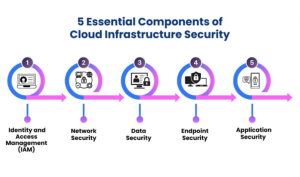
Here’s a table that describes how each component contributes to strengthening cloud security:
| Component | How It Works |
| Identity and Access Management (IAM) |
|
| Network Security |
|
| Data Security |
|
| Application Security |
|
| Endpoint Security |
|
Cloud Security Risks that Every Business Should Address
The adoption of cloud services shows no signs of slowing down. It means the importance of cloud security continues to grow as well.
Let us explore the risks driving heightened security concerns in cloud computing.
1. Misconfigurations
Threat actors can exploit your systems and network misconfigurations as entry points. It allows them to move laterally across the network and access your confidential resources. These misconfigurations may happen due to overlooked system areas or improper security settings.
How to Overcome?
- Use a cloud security posture management tool to audit and remediate configurations.
- Implement least privilege access to cloud resources.
- Incorporate IaC to maintain consistent configurations.
2. Lack of Visibility
While you are shifting operations, assets, and workloads to the cloud, you may want to give the responsibility of managing certain systems and policies to contracted providers. As a result, you might lose visibility into some network operations, services, and resource usage and cost.
How to Overcome?
- Implement centralized logging and monitoring solutions.
- Set up alerts for unusual or unauthorized activities.
- Regularly review and prune unnecessary resources.
3. Insider Threat
Insider threats happen due to insiders who already have some degree of access to or knowledge of an enterprise’s cloud environment. They could be current or former employees, third-party vendors, or partners. These threats could occur due to accidental errors, negligence, or malicious intent.
How to Overcome?
- Monitor employee activity for suspicious behavior.
- Offer training on cybersecurity.
- Implement strict access controls even for trusted insiders.
4. Insecure APIs
APIs enable businesses and individuals to sync data, customize the cloud service experience, and automate data workflows. However, APIs that fail to encrypt data can cause cross-system vulnerabilities, affecting the entire cloud ecosystem.
How to Overcome?
- Implement a strong authentication and authorization mechanism.
- Use rate limiting and other controls.
- Regularly scan APIs for vulnerabilities.
How Businesses Can Protect Themselves?
With cyberattacks taking new shapes every day, adopting protective measures is crucial for businesses. However, setting up a team of cybersecurity experts can be expensive. That’s why, partnering with a cloud security service provider, like Agency 1987, can give enterprises structured protection without adding internal complexity.
Instead of managing every control on your own, the service provider’s team will set up a continuous monitoring process, enforce security policies, and ensure your cloud infrastructure adheres to the best security practices.
The cloud security service provider starts with a cloud security assessment to analyze your current set-up and reviews the configurations, identities, network controls, and workload exposure. Accordingly, the team or consultants recommend implementing the following solutions:
- Cloud Security Posture Management (to detect and fix misconfigurations)
- Identity and Access Management Hardening (to give every user a certain level of access permission)
- Security Information and Event Management (to monitor logs, network traffic, and user activity in real time)
And also, providers manage vulnerability scanning, API security checks, back and recovery planning, and data encryption oversight to ensure your data stays protected even during incidents.
Cloud Security Trends to Watch in 2025
To address new cyberattacks every day, cloud security is continuously evolving. Here are the top 4 cloud security trends to watch in 2025:
- AI-based threat detection: Smart AI-based tools use machine learning algorithms and advanced frameworks that can analyze patterns, behavior, and detect anomalies in real time and send alerts even before the attack unfolds.
- Automated compliance monitoring: Adhering to multiple standards and regulations has become critical. Automated tools can notify teams of policy deviations and generate audit-ready reports in no time.
- Supply chain and vendor risk management: Integration with third-party vendors is vulnerable. Organizations are demanding stronger transparency and proof of security from software vendors and cloud service providers.
- Unified cloud security platforms: Integration of fragmented security tools into centralized platforms. This will help minimize complexity and operational costs.
Real-World Examples of Cloud Security Success
Here are some popular brands that use cloud security solutions to protect their businesses.
- Netflix: Runs entirely on AWS with zero-trust security, where every user and service must verify identity before accessing any resources.
- NASA: Migrated space mission data to AWS using government-approved FedRAMP security standards to keep everything encrypted and compliant.
- Spotify: Stores all music and user data on Google Cloud with custom-built security scanning tools that automatically check for vulnerabilities.
Conclusion
Cloud Computing will remain the backbone of IT infrastructure from 2025 and beyond, thanks to its flexible and cost-effective solutions for businesses. However, with the increased use of cloud services, there will also be a rise in cyberattacks. Therefore, you should implement advanced security measures to stay ahead of the cybersecurity threats as cloud environments grow more complex.
Your cloud security solution needs to be proactive, AI-driven, and extremely adaptive to sophisticated cyberthreats. From environment to compliance, every step needs to be monitored with vigilance and expertise.
But you don’t have to do it alone. Partner with our team to develop a cloud security strategy tailored to your business needs. Contact us today to learn more!
Frequently Asked Questions
Q1. How Can Businesses Guarantee Cloud Security?
Businesses can improve their cloud security by setting strong access restrictions, encrypting data, doing regular security audits, and providing regular training to their staff.
Q2. How will cloud security affect business operations in 2025?
An effective cloud security allows for continuous operations by protecting data integrity. It ensures compliance and builds confidence among stakeholders and consumers.
Q3. What role will AI play in Cloud security in 2025?
AI is being rapidly utilized for predictive analytics, anomaly detection, and automated incident response to find and overcome possible risks before they disrupt business operations.